




From 24 to 28 November, the Innovation Co-creation Laboratory (IKL) took place in Vidzeme, where students, researchers, and entrepreneurs worked on challenges defined by local businesses in the sustainable food and beverage technology sector. This year, eight companies from six municipalities of the Vidzeme region participated, presenting ten real business development challenges at the core of the program.
Based on the jury’s evaluation, researchers and students from the three highest-rated teams also received scholarships to further develop their ideas:
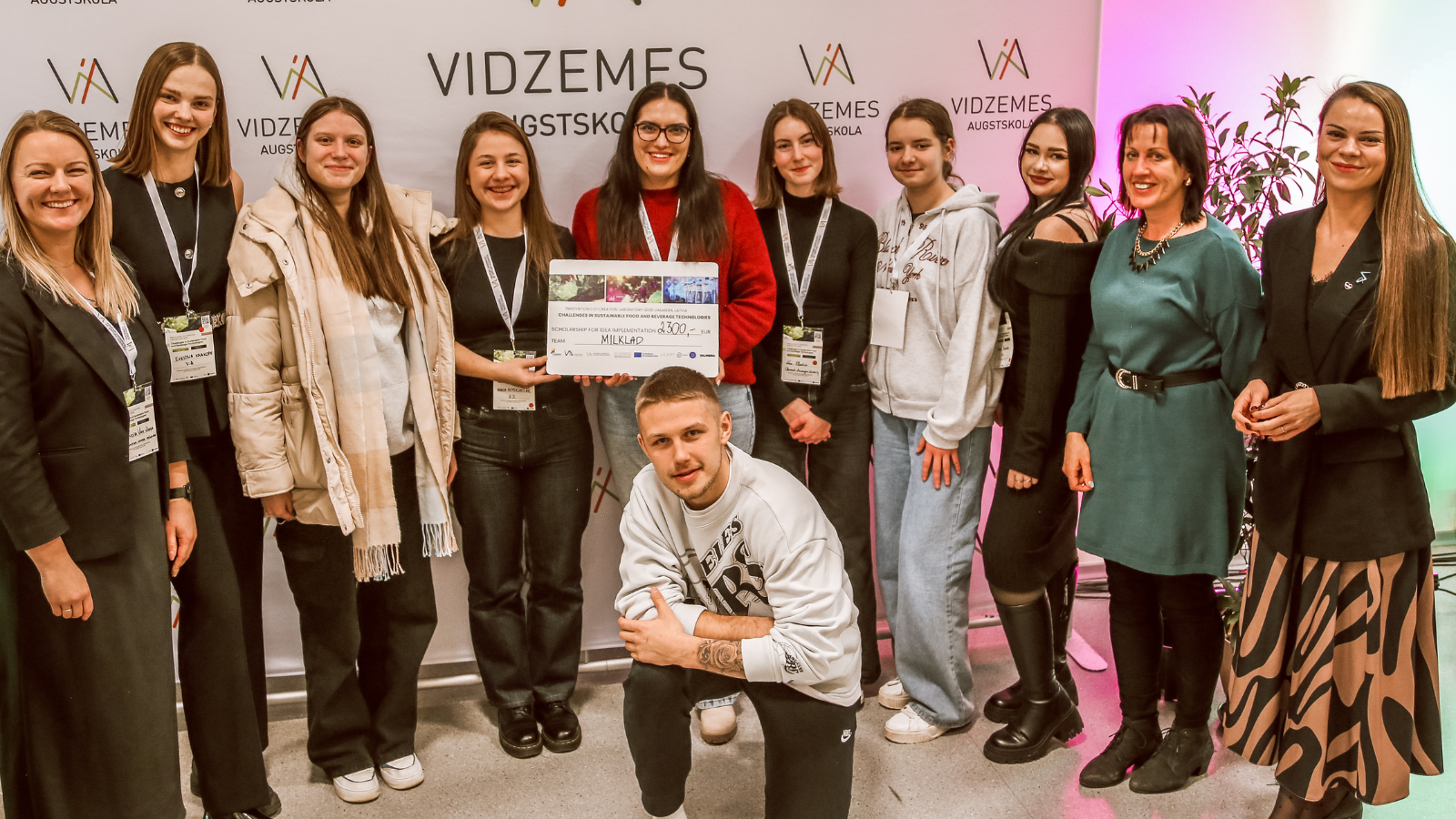
Team “MILKLAD” worked on the challenge set by AS Smiltenes Piens:
“Valorization of whey proteins by transforming them into new sustainable products to increase protein intake.”
The team received 1st place and a €2300 scholarship for further research.
Team “GUT FEELING” worked on the challenge posed by Valmiermuižas alus:
“Exploration of next-generation fermented non-alcoholic functional beverages.”
The team received 2nd place and a €1700 scholarship for further research.
Team “WILD FLOWERS” worked on the challenge from SIA PLŪKT:
“How to make the fermentation process of fireweed (Ivan Chai) more efficient, automated, and suitable for larger production volumes while reducing manual labor.”
They received 3rd place and a €1000 scholarship for further research.
Throughout the week, students working alongside industry specialists generated hundreds of ideas that provided deeper insight into how companies think, the challenges they face, and the competencies that will be needed in the future. This experience not only broadens young people’s perspectives but also helps shape their professional mindset by offering a practical view into the regional business environment. Several of the ideas generated could become the basis for personal business projects, research initiatives, or further innovation development.
Vidzeme University of Applied Sciences student Ēriks Ralfs Blaubergs notes that “participation in the Innovation Co-creation Laboratory was a particularly powerful experience.” He emphasizes that the team was fortunate with their assigned challenge, and throughout the process— from coordinating tasks to generating ideas—he rediscovered a long-lost joy for this type of project. As the week drew to a close, he already felt the shift back to everyday life, but he most appreciated the opportunity to work with such a strong and motivated team. Each member significantly contributed to the development of the solution with their ideas and effort. Alongside Vidzeme University students, participants from Valmiera Vocational Training Centre joined the teams, and every contribution played an important role in achieving the final results.
Meanwhile, Līga Ostrovska, head of the confectionery production plant at SIA Fazer Latvija, notes that the IKL week was particularly valuable for the company. She described the experience of working with entrepreneurs and researchers as wonderful, and the situations addressed directly reflected Fazer Group’s core values, where sustainability plays a key role. Ostrovska emphasized that the team genuinely enjoyed the process and achieved concrete results—and they already plan to meet with colleagues soon to discuss the new ideas generated during IKL.
For businesses, such collaboration is essential—they gain the opportunity to see their challenges from a new perspective, meet potential future employees, and often receive solution ideas that would take significantly longer to identify on their own. For researchers, it is a chance to better understand industry needs and tailor their work toward practical, applied research. It is often observed that researchers and entrepreneurs rarely meet in everyday work, but such platforms create an environment where collaboration becomes natural and purposeful.
Santa Vītola, head of VAIC, highlights the importance of such events for regional development:
“The Innovation Co-creation Laboratory format very practically strengthens cooperation between business, education, and research in our region. This is also the essential role of VAIC—to build and develop a knowledge and innovation ecosystem in Vidzeme by bringing together the interested parties. We attract research resources not only from Vidzeme but from all over Latvia and Europe. This provides tremendous added value for our companies, as they gain an international perspective on their development challenges.”
Although Vidzeme University does not have study programs directly focused on food and beverage technology, IKL demonstrates that ViA can still serve as a significant driver of innovation in this regionally important sector.
Businesses participating in the Innovation Co-creation Laboratory included:
Fazer Latvija, AS Smiltenes Piens, Valmiermuižas alus, Rūjienas Saldējums, PLŪKT, Alūksnes putnu ferma (Fiteg²), Z/S Augšbirzes, and Strenču Psychoneurological Hospital.
Researchers participated from Vidzeme University of Applied Sciences, the Children’s Clinical University Hospital, the Latvia University of Life Sciences and Technologies, and the Institute of Agricultural Resources and Economics.
The Innovation Co-creation Laboratory was organized by the Vidzeme Open Innovation Centre under the Erasmus+ Blended Intensive Program, in cooperation with the European University E³UDRES², LEAPXR, and Valmiera Municipality.
